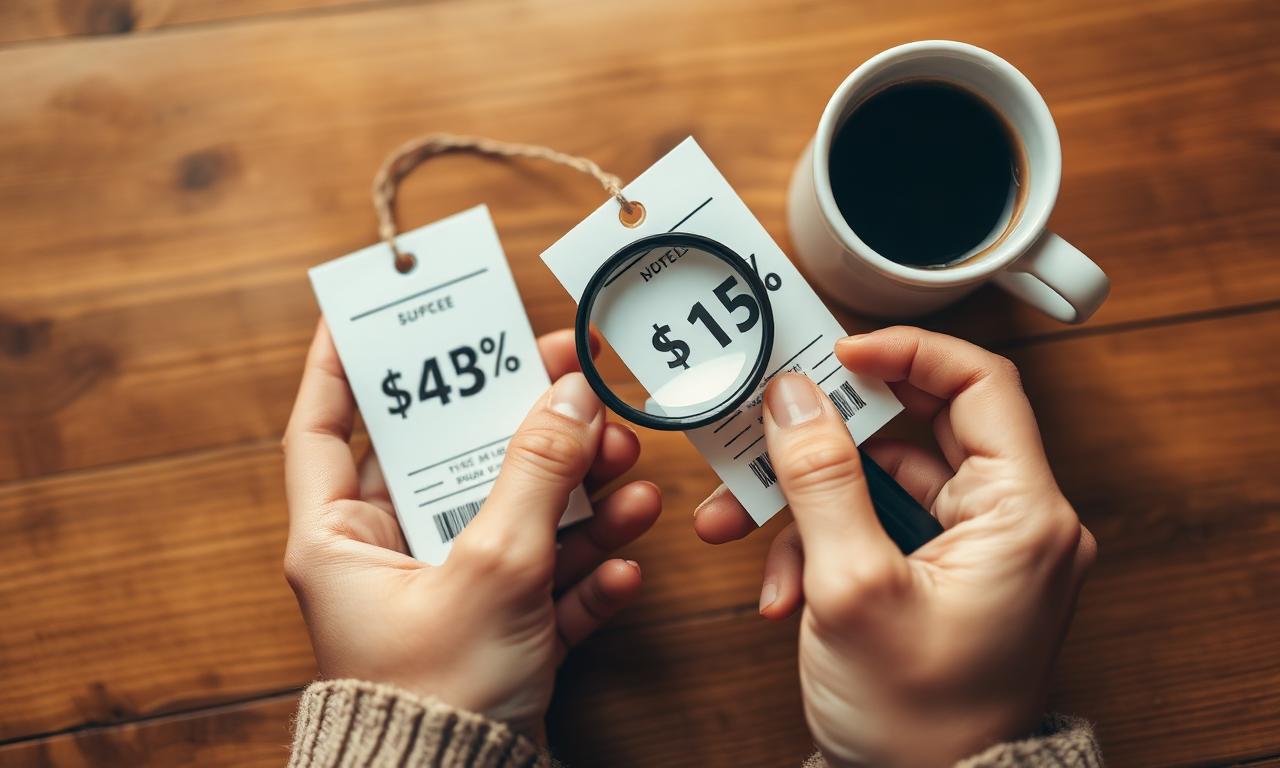
"Sale," "limited time," "today only," "lowest price of the year." If you've ever wondered whether any of those phrases actually mean anything, you're not alone. Retailers know that the appearance of a discount is often as persuasive as a real one — which is exactly why a little skepticism pays off.
Start with the original price
The most important number on a sale tag is the one that's crossed out. Was that ever actually the regular price? Or is it a "manufacturer's suggested retail" that nobody pays? A quick search for the same product at another retailer usually tells you within a minute.
Check the price history before you trust the badge
Many products quietly fluctuate in price throughout the year. A "30% off" sticker isn't impressive if the item was the same price two weeks ago. Browser extensions and price-tracking sites can show you the trend at a glance — if today's sale price is roughly the average, it's not really a deal.
Look for the small print
- Is the discount only on a specific size or color?
- Does it require a minimum spend?
- Is it bundled with a more expensive item?
- Does it exclude exactly what you wanted to buy?
The headline number is designed to grab attention. The fine print is where the actual offer lives.
Beware of countdown timers and "only X left"
Urgency cues are some of the oldest tools in the marketing playbook. They're effective precisely because they short-circuit your ability to compare and reflect. If a deal would still be a good deal tomorrow, the timer doesn't matter. If the timer is the only thing making it feel good, that's a signal — not a savings.
Compare total cost, not just the item
A low headline price can hide expensive shipping, mandatory accessories, or short return windows. Always look at the final number at checkout — not the one on the product page — before deciding the deal is real.
Ask whether you'd buy it at full price
This is the simplest filter of all. If you wouldn't pay sticker for it, a discount doesn't transform it into a purchase you needed. Saving 40% on something you'd never have bought is still spending 60% on something you didn't want.
Trust curated sources over noisy ones
Generic deal feeds tend to surface everything labeled "sale," good or bad. Curated sources — newsletters, member programs, communities that vet offers — filter out the noise so you only see deals that meaningfully beat the regular price.
A quick checklist before you buy
- Have I seen this item cheaper recently?
- Is the "original price" believable?
- Would I want this if it weren't on sale?
- Is the total cost (with shipping and fees) actually lower than alternatives?
- Can I walk away from it for 24 hours and still want it?
Run through that list and you'll dodge most fake-discount traps. The best deals stand up to scrutiny — and the ones that don't usually weren't deals to begin with.